
The BBIC was constituted in July 2015 to oversee the implementation of the guideline developed by the Judiciary to give direction to the administration of bail and bond in courts and police stations and decongest prison facilities
The guidelines seek to establish fairness and bring consistency and standards in bail/bond terms and guide police and judicial officers in the application of laws that provide for bail and bond. Further, they seek to emphasize oversight mechanisms and inter-agency co-ordination as well as public sensitisation. This is to ensure the rights of suspects and accused persons to liberty and to be presumed innocent are balanced with the public interest, including protecting the rights of victims of crime.

The committee is expected to develop practice directions/guidelines for use by various stakeholders on bail and bond application, develop legislative proposals to inform law reform on bail and bond administration and monitoring and reporting on the application of the policy guidelines among other activities.The policy directions outlined in the new guidelines emphasize
- Release on bail/bond as a constitutional right
- Reasonable bail terms and the right to review them
- Information on granting/denial of bail/bond
- Special consideration for the vulnerable – the children, the elderly, lactating mothers, Trans-gender and Inter-sex cases,
- Persons with Mental Disability Participation of victims in bail/bond processes
- New approach to minor traffic cases Particular attention to transnational offences
Commitees
- Court Users’ Committee
- Bail & Bond Implementation Committee
- Special Taskforce on Children Matters
- Criminal Justice Reform Committee
- Working Committee on Traffic
- Active Case Management
The committee is responsible for:
- Conducting sensitization and training exercises among the relevant stakeholders and the public generally on the application of the bail and bond terms and related matters.
- Engaging the relevant actors as necessary to enable operationalization and the streamlining of the bail and bond processes across all relevant justice sector actors.
- Recommending and/or undertaking such measures, including legislative interventions as necessary to achieve the operationalization of the recommendations of the Taskforce by the relevant agencies.
- Monitoring, evaluating and reporting on the implementation of the Bail and Bond Policy Guidelines and Recommendations contained in the Report of the Taskforce.
It is chaired by the Presiding Judge, Criminal Division of the High Court, Nairobi, Lady Justice Jessie Lesiit. Members are drawn from:
- Department of Childrens’ Services
- Independent Policing Oversight Authority
- Judiciary Training Institute
- Judiciary
- Kenya Law Reform Commission
- Kenya National Commission on Human Rights
- Kenya Prisons Service
- Law Society of Kenya
- Legal Resources Foundation
- National Council on the Administration of Justice Secretariat
- National Police Service
- National Transport and Safety Authority
- Office of Attorney-General
- Office of the Director of Public Prosecutions
- Probation and After Care Services
A bond is an undertaking entered into by an accused person to comply with conditions set by the court as a condition for his/her release while awaiting or continuing with trial. There are two forms of bonds: personal bond (free bond) and bond with surety.
A person who binds himself /herself to ensure that an accused person will attend court and comply with the conditions set by the court. A surety can be discharged from standing in for the accused. When a surety is discharged; an accused person is apprehended until he provides another surety to meet the set bail bond terms.
Personal bond is a written agreement in which a person who has been arrested agrees to appear at all required court dates and promises to abstain from breaking the law while the personal bond is in force. Once the agreement is signed, the arrested person is released from custody.
Bail is an agreement between suspect or accused person with the police/court that the accused person will attend court when required, and that should the accused person fail to appear, the court may issue warrants of arrest, and order forfeiture of the amount deposited.
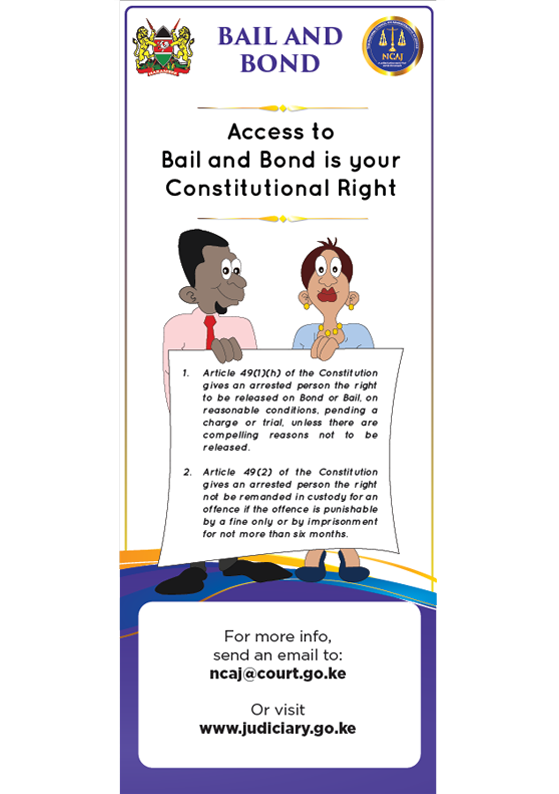
It is your constitutional right to be released on bond or bail, on reasonable conditions, pending a charge or trial, unless there are compelling reasons not to be released. You shall not be remanded in custody if the offence you face is punishable by a fine only or by imprisonment for not more than six months.
No.
It simply means that you are free as long as you abide by any conditions set by the police or court.
Yes. What happens?
If there are compelling reasons not to, the police will not grant you Bail, meaning that you will be in remanded in custody as you await to be charged. Whether or not there exists compelling reasons depends on the circumstances of each case.
Yes. What happens?
If there are compelling reasons not to, the police will not grant you Bail, meaning that you will be in remanded in custody as you await to be charged. Whether or not there exists compelling reasons depends on the circumstances of each case.
The Officer in Charge of a Police Station has power to release arrested person upon execution of bail to secure their court attendance. The amount paid is refundable and once furnished, an arrested person is entitled to be immediately released.
One is entitled to a refund of the whole amount deposited on his/her first appearance in court. Note that Bail amount is not an equivalent to a fine or bribe. In case no charge is preferred and the amount of cash bail has not been deposited with the court, you should go back to the OCS concerned to get a refund.
Bail is not a fine. Bail is meant to secure ones attendance to court and is refundable once the matter is concluded. A fine on the other hand is a form of penalty that is given when a person has either admitted the charge or has been tried and convicted of the offence. A fine once paid is not refundable unless there is a successful appeal.
Once you are charged, the court will order your release on Bail or Bond on reasonable terms, unless there are compelling reasons not to. The burden is on the prosecution to prove that indeed, there exists compelling reasons not to grant you bail.
Compelling reasons entail undeniable factors that the court considers justifiable to deny bail to an accused person.
There are various forms of security documents that the courts can ask you to furnish. The most common being land title deeds, salary payslips, car logbook, Share Certificates etc. These have to undergo a verification process to confirm whether they are genuine and sufficient for the amount of security required.
Yes.
When the accused person is unable to meet the Bond terms, he/she may apply to court for review. The accused may also orally request the court for review the terms in subsequent mentions of his/her case. The court may also request for a Bail information report from a Probation Officer before reviewing bail terms.
Yes.
If you breach any of the conditions attached to the Bail or Bond, the court may subsequently vary or revoke the bail terms altogether. Where more charges are preferred against an accused person the court may vary or revoke the Bond terms.
A Probation Officer is an officer of the court appointed under the Probation Offenders Act Cap 64 (Laws of Kenya) to provide advisory information on an accused.
A Probation Officer is an officer of the court whose role is to provide advisory information on an accused when requested by the court. The advisory information may include the background of the accused, a statement from the victim of the offence, local administration and the community. The purpose of the report is to inform the court on the suitability of granting or denying Bail to the accused.
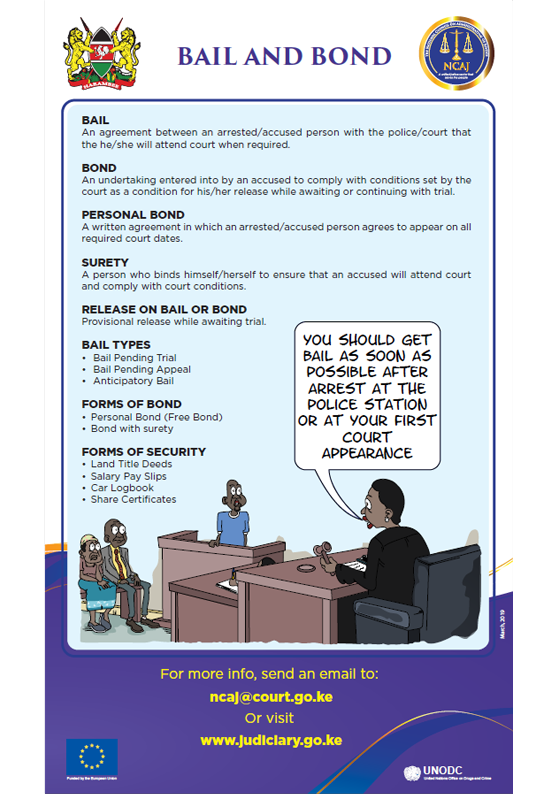
Bail & Bond definitions poster – English

Know your rights roll-up banner
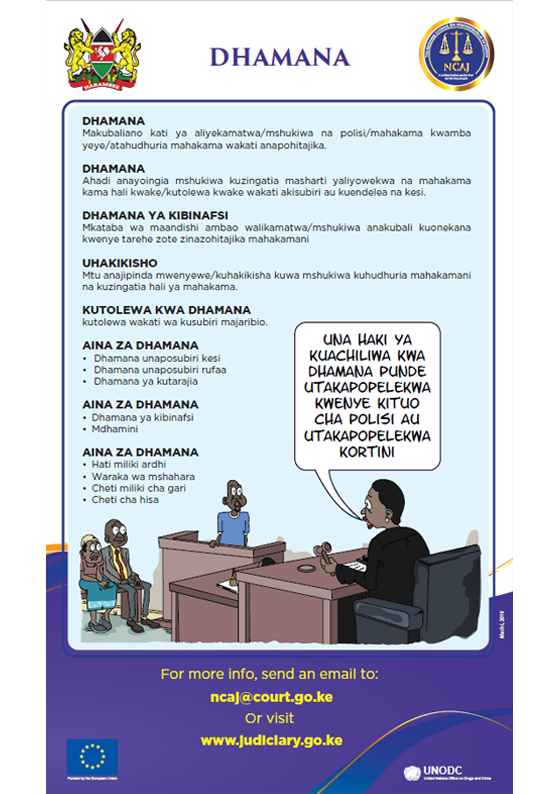
Bail and bond definitions poster – Swahili
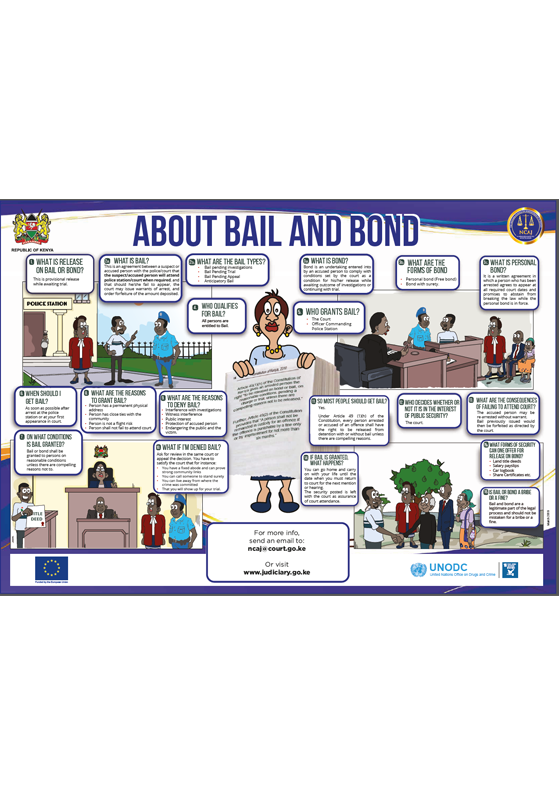
Bail and bond illustrated poster
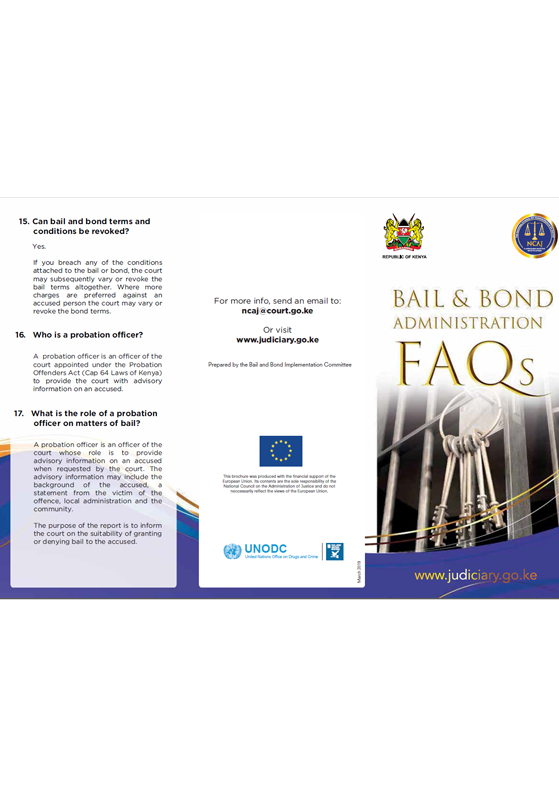
Bail and Bond FAQs – English

Bail and Bond Stickers – Swahili
Bail and Bond Stickers – Swahili